Nietzsche Drager
( INSTALLATION ART – 1996 – present )
A selection of INSTALLATION ART

(INSTALLATION ART)
Untitled Artist Files, 2011
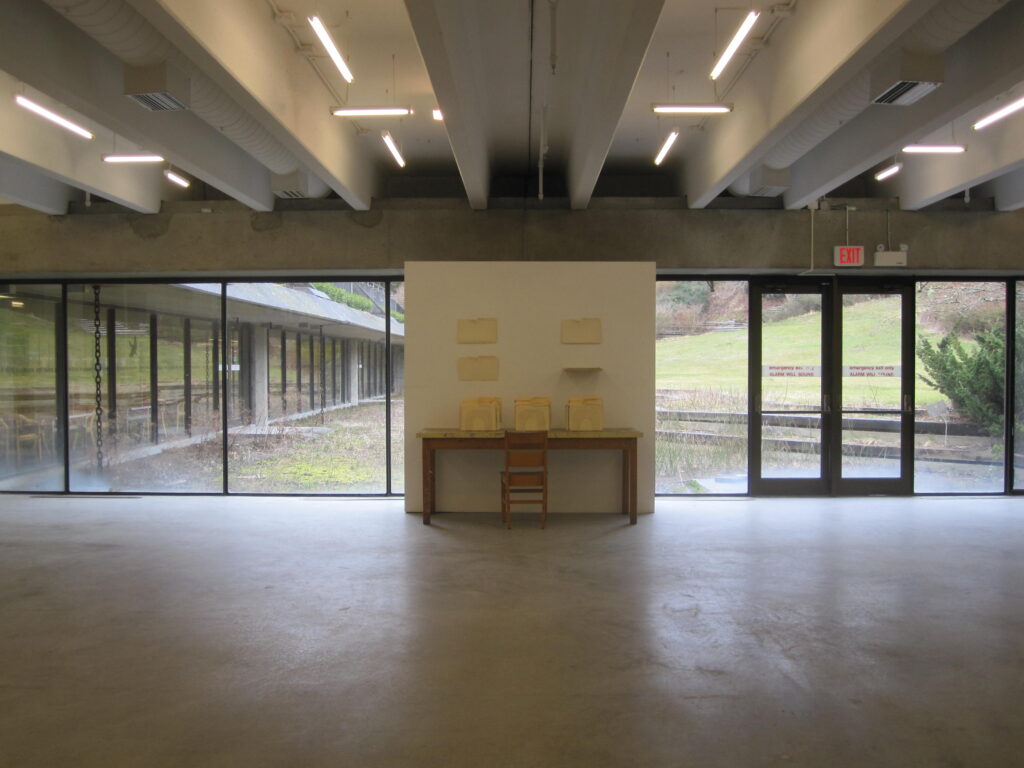
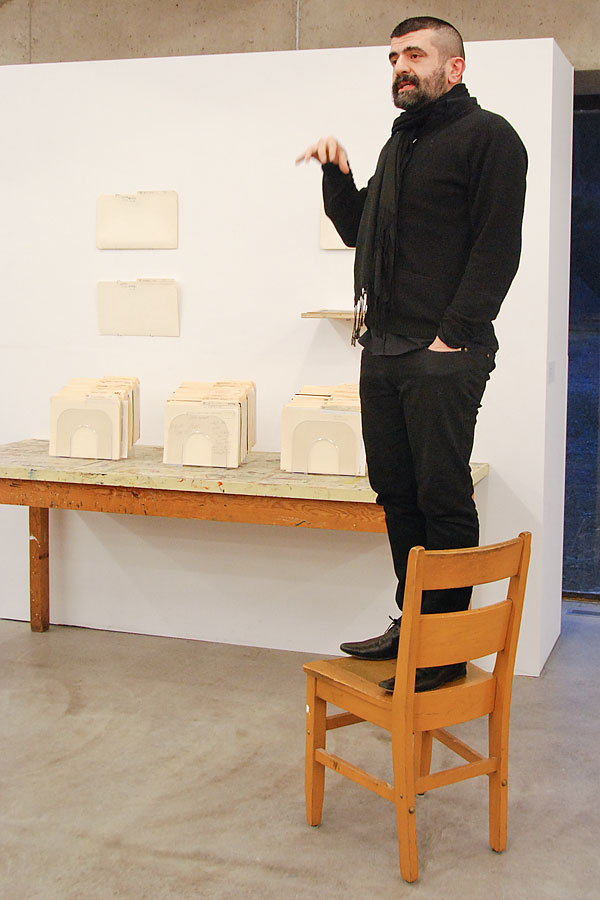
Mo Salemy standing on chair
Group Exhibition: Contemporary Histories- Intersecting Pasts and Futures, AHVA Library Gallery (University of British Columbia) Canada, Artist: Nietzsche Drager, Curator: Mo Salemy, 2011

Untitled Artist Files
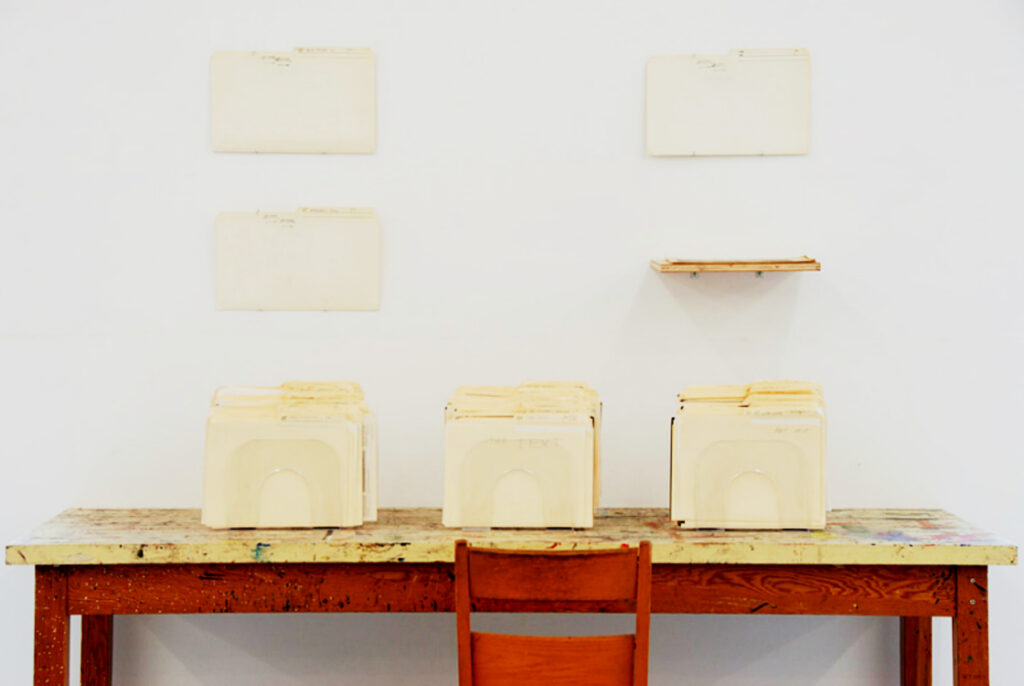
Magazine pages (Vanguard. Canadian magazine), Biege Paper File Folders, Plastic File Holders, Wood Shelve and Magazine, Table (University Class), Chair (University Class), Wood Shelves
4 feet x 6 feet x 10 feet
2011
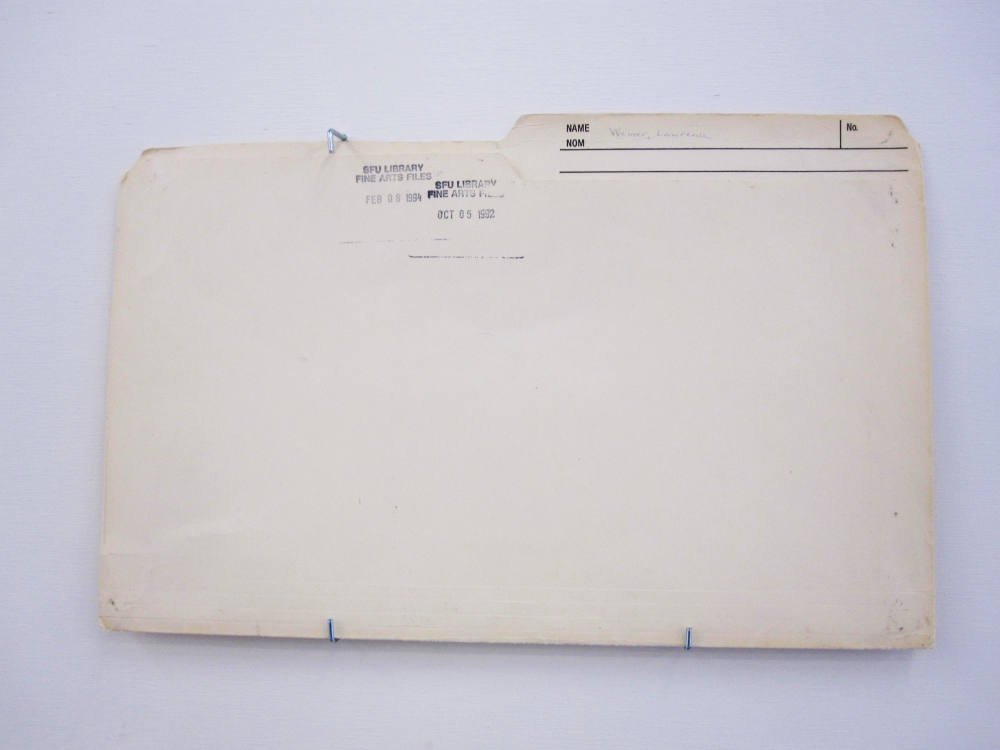
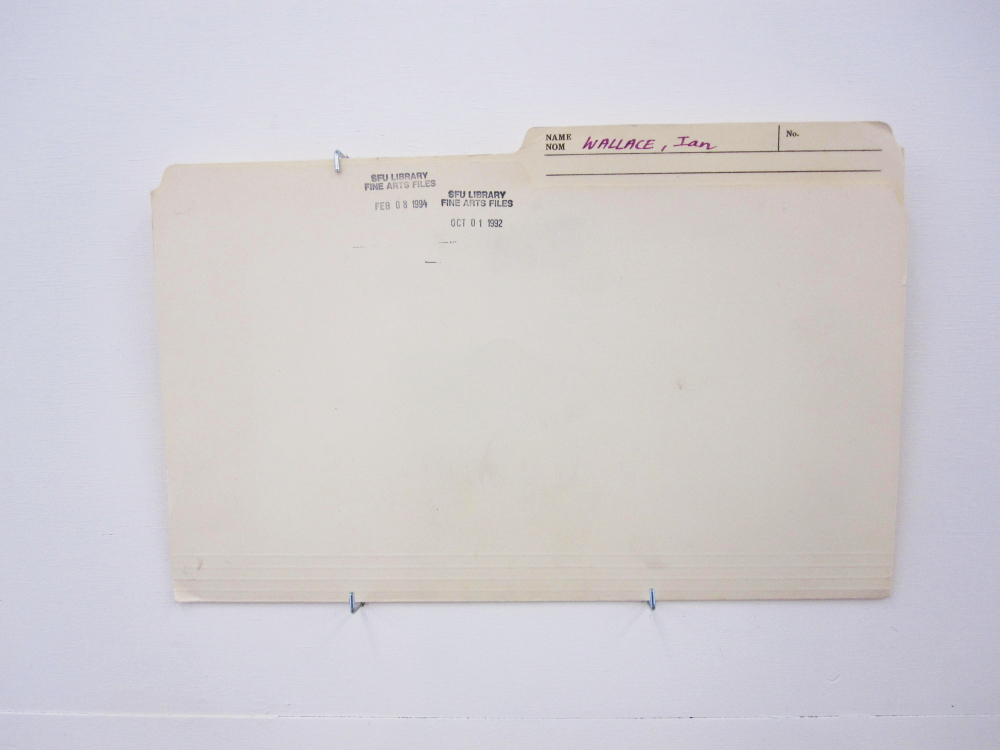
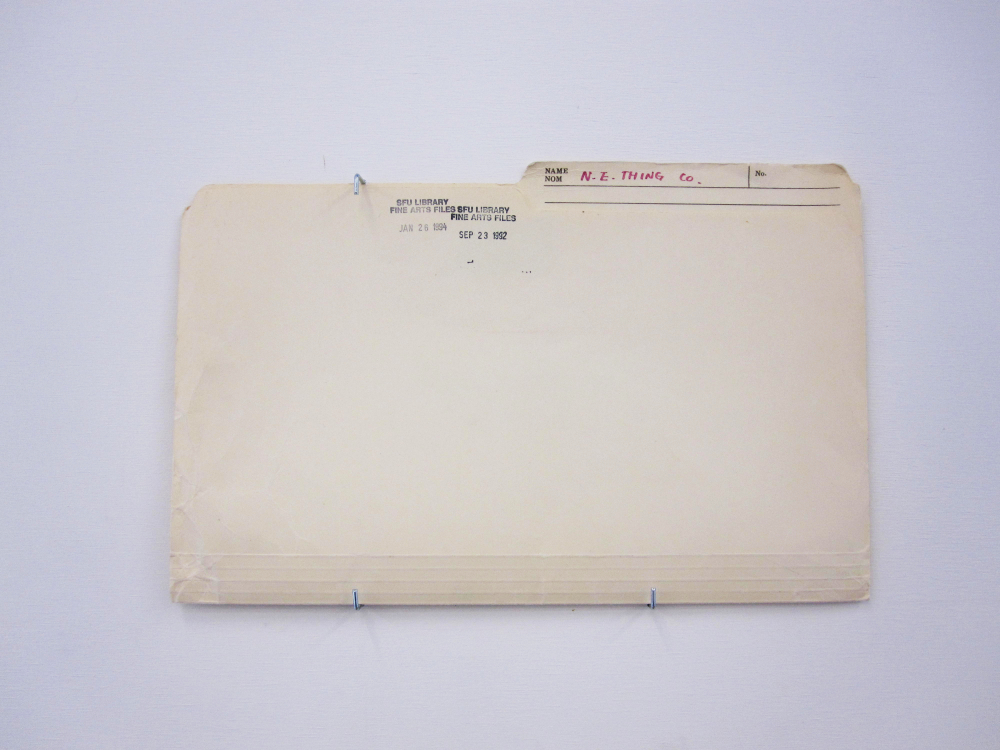
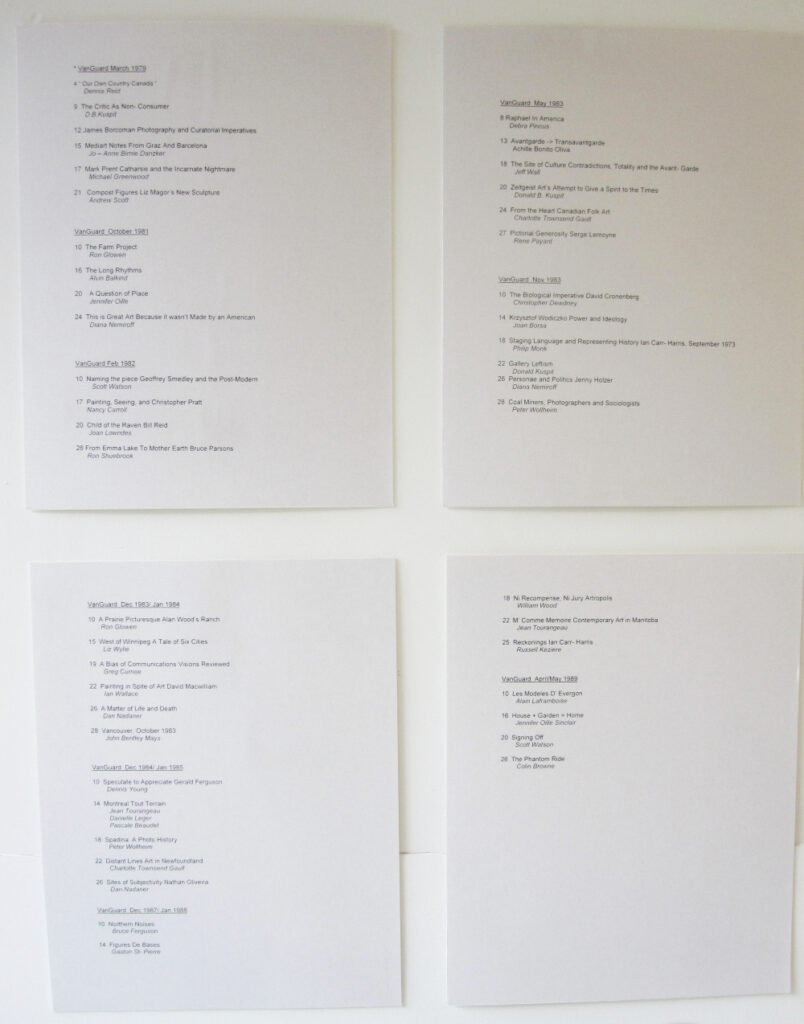
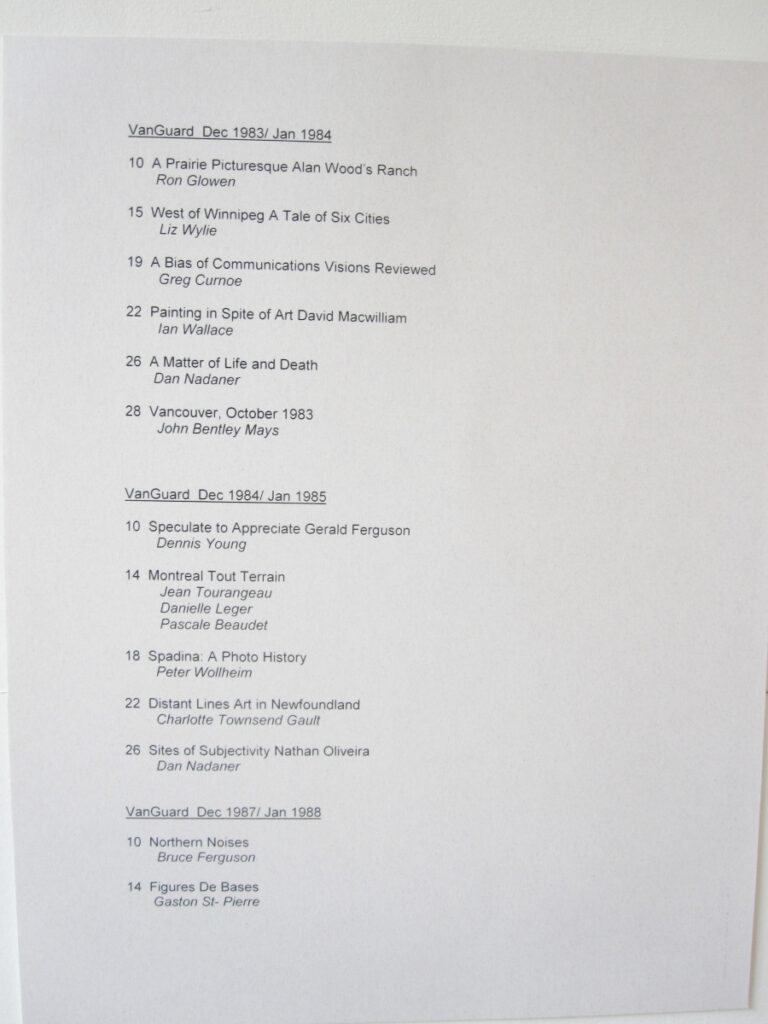
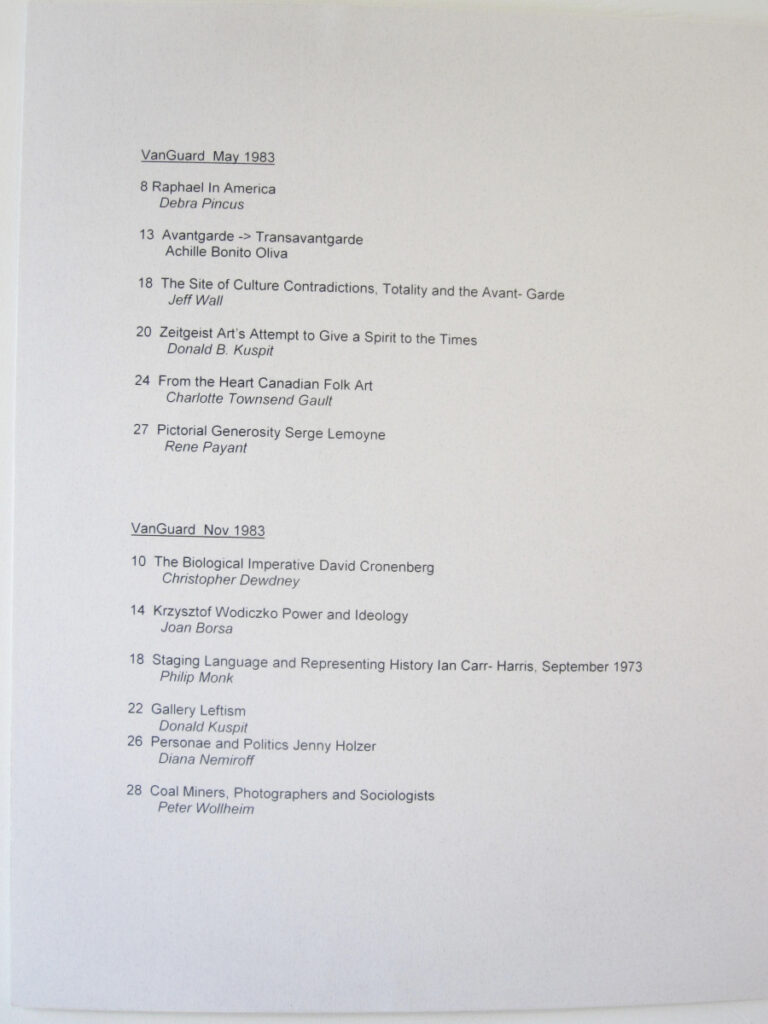
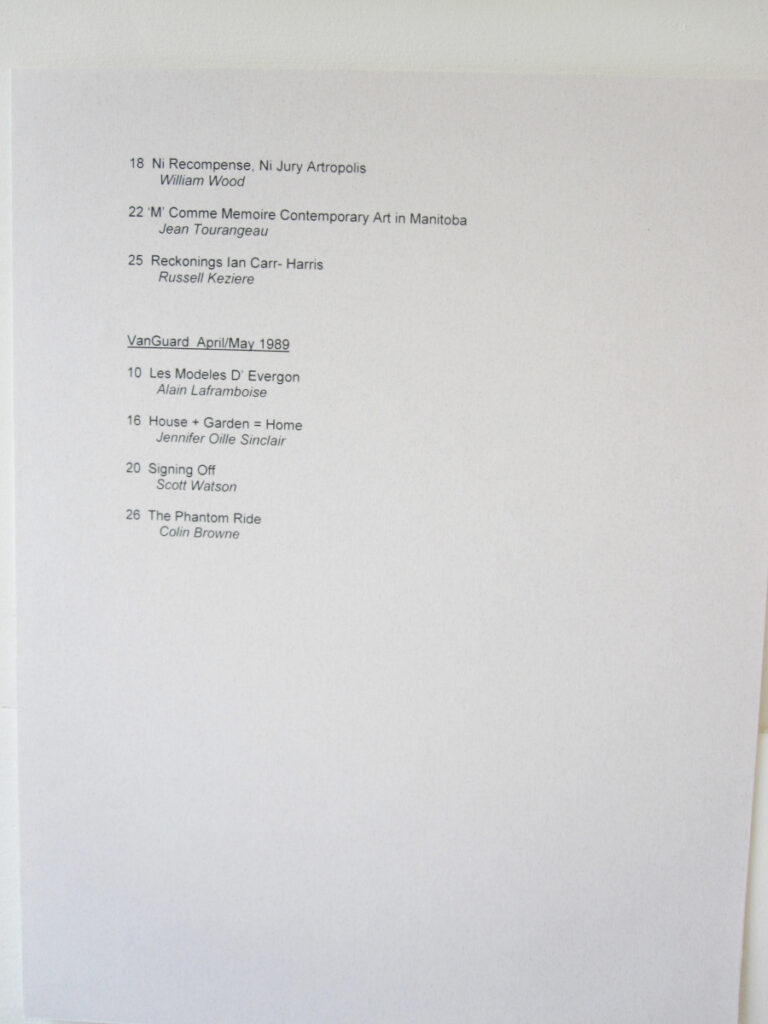
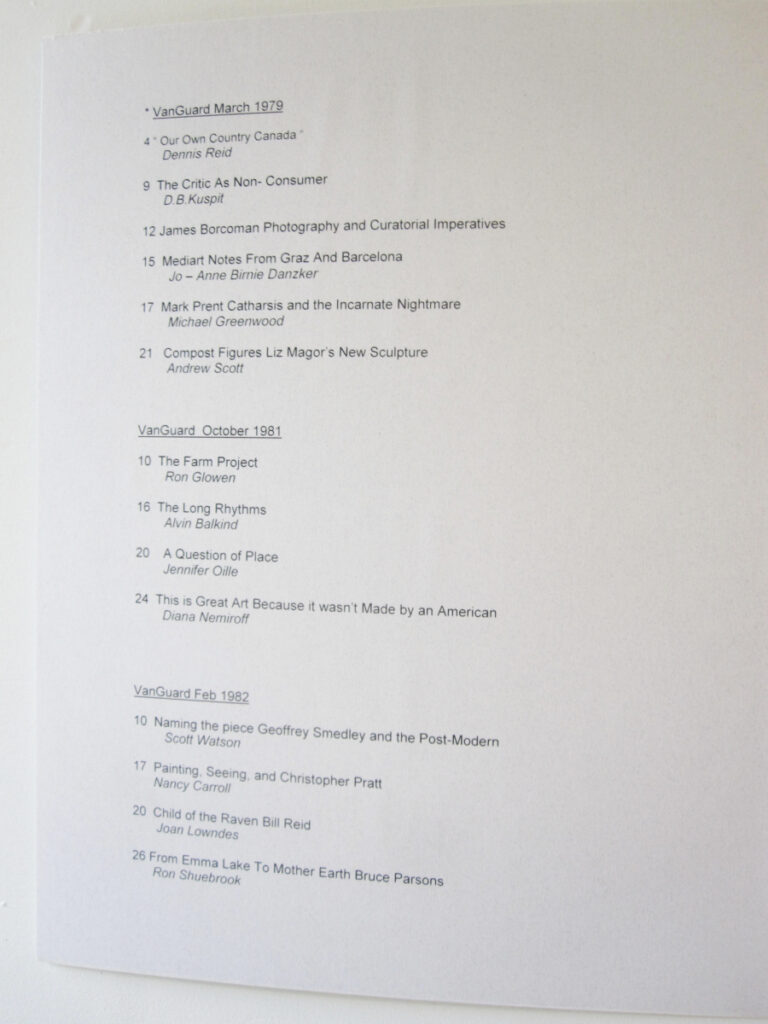
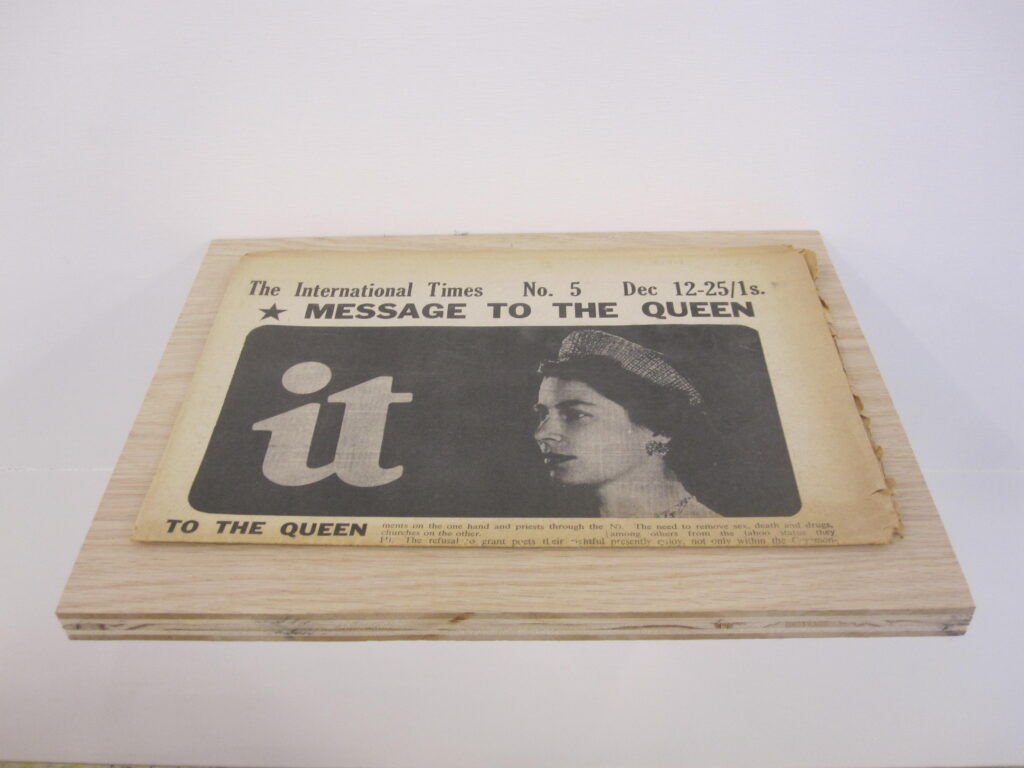
Untitled Artist Files is an installation of four parts – 1) mounted sucues 2) Biege Paper File Folders,Magazine pages (Vanguard. Canadian magazine) Plastic File Holders, 3) Table (University Class),and Chair (University Class), 4) wall text description. First, 3 mounted artist files from the SFU library- Lawrence Wiener, Ian Wallace, N.E. Thing Co., mounted on the wall, then 1 mounted wall shelf displaying a 1960s U.K. alternative newspaper- The International Times. Second, a desk and chair, taken from various places from the U.B.C. campus. Third, three plastic file holders on the table, holding numerous Biege Paper File Folders files – Drager’s personal files, standard letter size , ( 9” X 11.5”) collected from December 2007- 2010 from Drager’s art and business practice, in which Drager randomly inserted into each file, one cut-out-page from 7 Vanguard magazines, ( Feb 1981; Sep 1984; May 1981; Nov 1984; Nov 1981; Oct 1985; Dec 1981; Dec 1985; Feb 1982; Feb 1986; May 1982; Dec 1987; Apr 1983, Sum 1983; May 1984) entirely dismantled. Fourth, a text panel, mounted on the side of the wall, describing the essays om he Vanguard magazines, which the pages were taken.
Untitled Artist Files, abstracts the linear structure of narratives, in a literal way, to articulate a sense of chaos in the consumption of knowledge, information, ideas.
.
(INSTALLATION ART) Proposal
Technique of the Self, 2017

Technique of the Self,
10 objects
paper,
7 in x 8 in,
2017
In this series, I take the paper edited from my art research – letters, photocopies, writing, drawings, etc, and mash them together with water into paper mache objects. This is a way of editing- destroying and constructing art objects in the context of Michel Foucault ‘s writing on Greek care of the self, part of a process of self inquiry and self examination, whereby we edit our work, towards learning more about the Self. When we create writing or art, we are editing as part of the creative process. So rather than simply throw out my edited documents- i.e. writing, I have turned these edited writings into an “art object”, a sculpture. In many ways, these are “artifacts” as residue of my art production.
(INSTALLATION ART)
Rodin’s Thinker, 2011
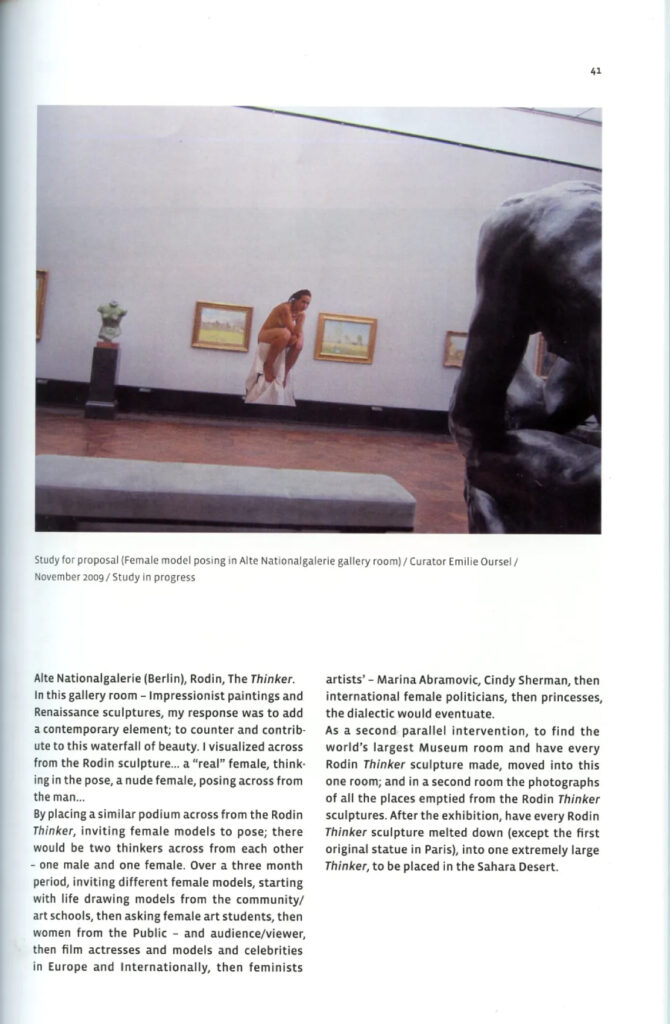
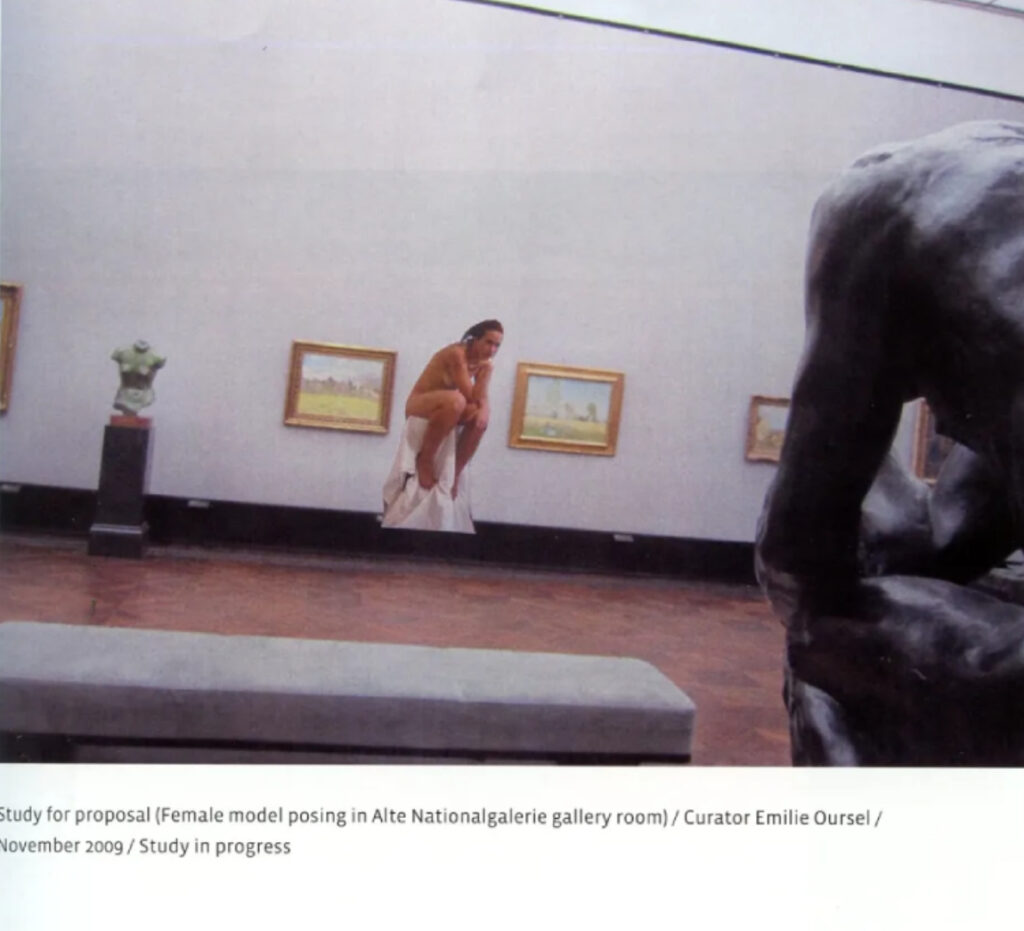
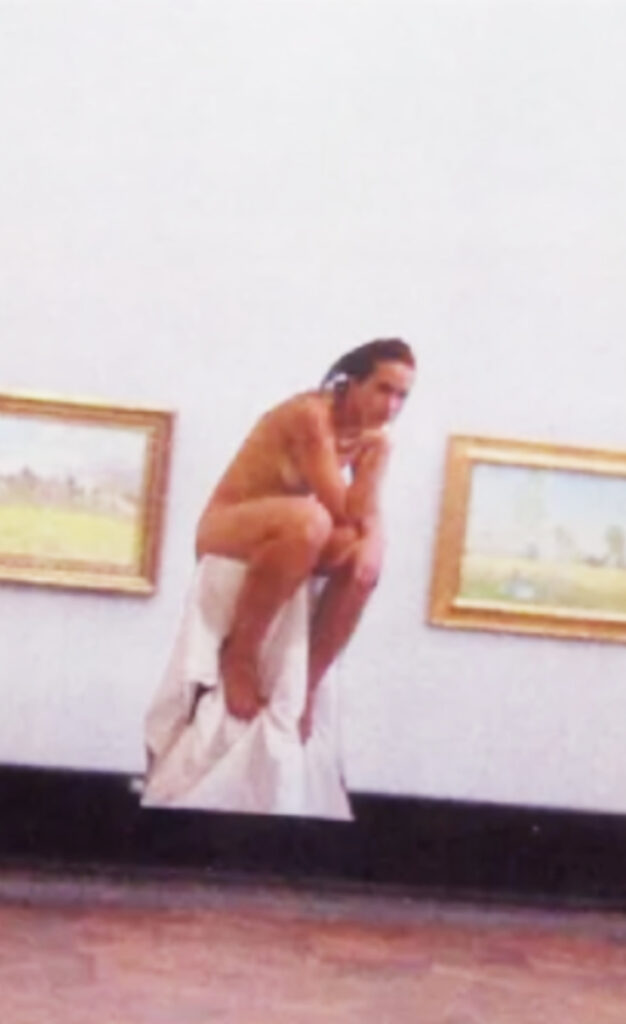
photograph by Nietzsche Drager ,2010
( ART ACTION / ART INTERVENTION / RECONTEXTUALIZATION / REFRAMING )
Rodin’s Thinker
Published Art Proposal ( Installation)
MOBILE ALBUM INTERNATIONAL ( ART Jou nal)
2010
A proposal for the Alte Nationalgalerie, Berlin.
Published in the art journal, Mobile Album International , 2010
Curator: Emilie Oursel ( su mitting to Mobile Album International )
Mobile Album International Editor :
Kerry Rae ( photographer), modelling as Rodin’s ‘Female Thinker’
Published Proposal
In this gallery room, of the Alte Nationalgalerie, are impressionist paintings and Renaissance sculptures that evoke my response to add a contemporary element to counter and contribute to this waterfall of beauty. Across from the Rodin sculpture ( which was not life size), I would place a similar podium, and invite female models posing nude, exactly like the Rodin Thinker; thus, there would be two thinkers across from each other- one male and one female. Over a three month period, the art action would invite different females to pose naked thinking, starting with life drawing models from the community/art schools, then female art students, then the females from the public, then female actresses in Europe and Internationally, then feminists artists, then international female politicians, then female Royalty.
A second intervention, from my internet research, would be to find the world’s largest Museum room and have every Rodin Thinker sculpture made, moved into this one room and in a second room the photographs of all the places emptied from the Rodin Thinker sculpture. And propose, after the exhibition, that every Rodin Thinker sculpture be melted down,( except the first original statue moved back to France,) into one extremely large Thinker to be placed in the Sahara Desert.
Rodin constructs a site of rethinking and re-seeing our Museum experience- one that can become a ‘happening’ in the Museum/institutional space. Also, it is to link the history of art- painting and sculpture, with a present contemporary art- performance, to discover the relations and dialectics between the two. Third, this work, creates or develops a moment where the viewer, becomes an artist, and active- how to rearticulate the passiveness of seeing into social engagement. Fourth, it is to try and understand the act of thinking.
Rodin’s sculpture is a very fascinating work. As I sat in the gallery room, many people would walk around the Thinker, and stare, and think look, at this man, a naked man, thinking.I love thinking. This act is fundamentally human. Our cognitive process is as much humans as our bodies. I think of , “I think, therefore I am”. Yet, also, ” I think, therefore I am free”. Thinking is a key to creating anything. And thinking is an act of freedom. Especially in art. And particularly in Western Democracies from the early 20th century- an art challenging our discourse, ideas, social norms, social structures, by recontextualizing things and ideas.
However, perhaps, Rodin’s thinker is not thinking; it just looks like he is; he is just in the pose of thinking, or in the pose of being in the moment – being.
To think and be naked, are two natural human conditions and aspects. To be naked is a truth in itself. To think is to seek a or the truth. To be naked is to be true to our simple nature, literally and metaphorically. We can not hide when we are naked. As such, the parallels between thinking and nakedness link in providing a basic rubric of dialectic to engage with our Cultural and Social selves in terms of origin or the nascent philosophical self in relations with others. To be naked or nude is a social precept or axiom.
In culture and in art, to celebrate the beauty of thinking and the naked self, is an affirmation of humanness which is a vehicle towards self emancipation and knowledge of the self in and outside of the social body.
( INSTALLATION ART / ART ACTION / ART INTERVENTION)
“Poet Theorist in Berlin”, 2011
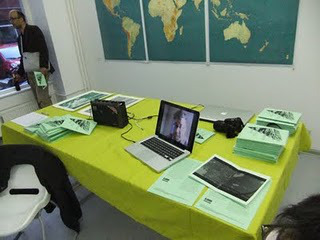
Skype Art Action ( ART ACTION / ART INTERVENTION )
“Poet Theorist in Berlin”
Artist Talk via Skype,
KuiperDomingosProject Space,
Berlin
2011
Nietzsche Drager particpated in an artist talk at the finissage of a solo exhibition of Christoph Both-Asmus’s work, Tree Walker, with Christoph Both-Asmus ( Artist ), Hans Kuiper ( Director ), Tiny Domingos (Director ), on Christoph Both- Asmus’s work, Tree Walker. The event was held on June 24 2011, 8pm Berlin time.
‘Tree Walker’ of Christoph Both-Asmus at KUIPERDOMINGOS PROJECTSThe first opening of Christoph Both-Asmus Show ‘Tree Walker’ has been a very nice event. Below you can see some photo’s of the opening night, which consisted of an interview with Christoph Both-Asmus by Hans Kuiper, an opening song by the Art Space initiators, the climbing of a tree by Christoph Both-Asmus and more, much more….!We want to thank all the contributors: Christoph Both-Asmus, Iris Holtkamp & Jan-Eric Stephan of 1405 who designed the website, flyer, project information and biographic page of Christoph Both-Asmus, Chika Takabayashi, Latasha D. Baker, Karim who took care of the catering.The show will be visitable till the end of June saturday’s and sunday’s 3-6pm and by appointment: Wriezener Strasse 12, 13559 Berlin.Website of KUIPERDOMINGOS PROJECTSWebsite of Christoph Both-Asmus
( INSTALLATION ART / Recontextualization / Reframing / Art Action / Art Intervention )
DADA CAFE, 2010

Installation logo, designed by in collaboration with Gouke Hilte ( STORM, publicist): with permission from Universal Records, Lady GAGA, Holland.

Entrance to the building, and DADA CAFE

Overall View of installation ( main room), Chess Table,( foreground) – participants could play chess, and Lemonade Stand ( Right) – participants were served lemonade in cups with one small hole , and Poetry Reading Room ( background) – could read rock lyrics in a mic with amp, and DADA Cafe written in oranges.
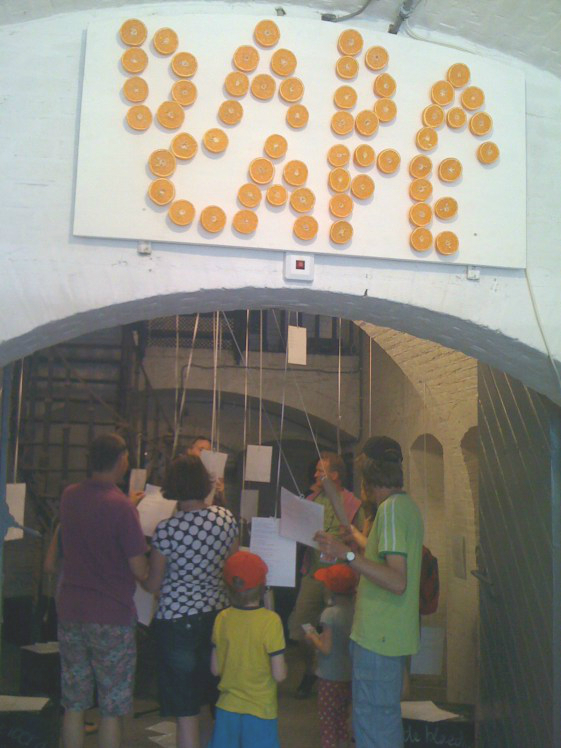
DADA CAFE” text written in sliced oranges above the arch in the main room.
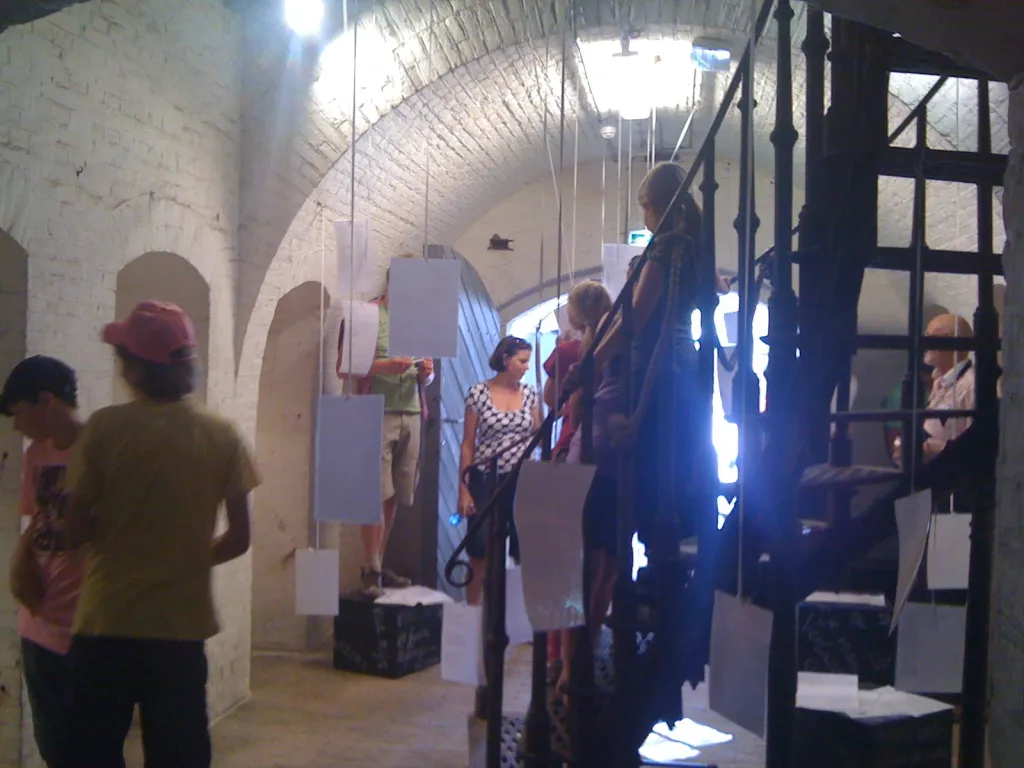
Poetry Reading Room, ( Installation View) rock music lyric sheets written in Dutch and English which could be taken off hooks for the participant to read from a microphone and electric amp
“When you walk to the entrance of the fortress you hear children singing LOUD!They stand on the stair/stage in Dada Café. It’s funny to see how some of them sing and others who are more aware of their surrounding and the people around them don’t.” – quote from a STORM staff
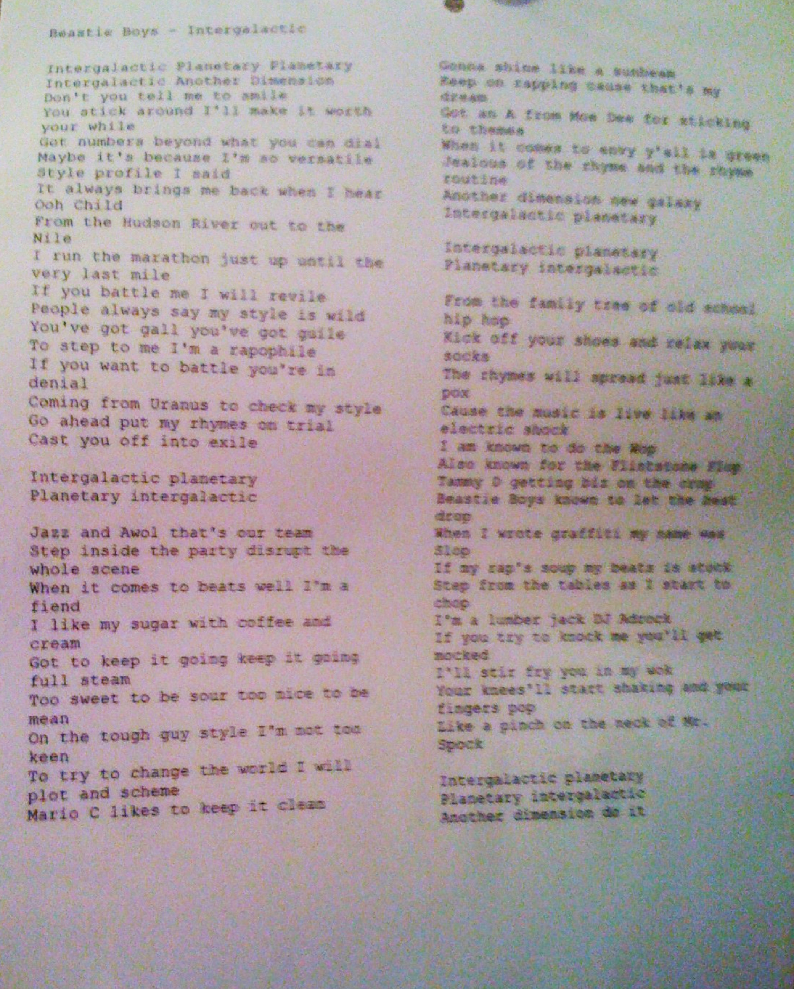
Poetry Reading Room, ( detail) song lyrics ; Beastie boys, Ramones, Sex Pistols, Smiths, Joy Division, the Cure, the Clash….etc
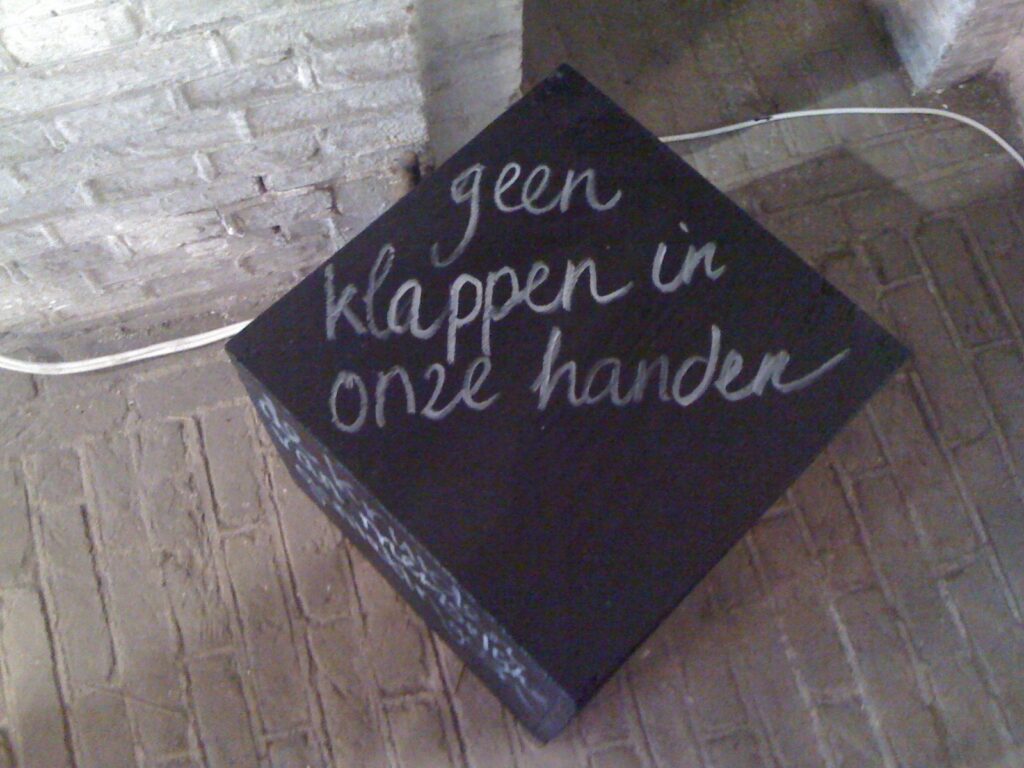

Library of Mailed Objects, ( detail) Objects primarily mailed from Vancouver, Canada, to the curator(s) Utrecht, Holland, by Nietzsche Drager and displayed on plinthes in a series of small alcoves in the poetry reading room. Mark Kremer printed the text on the plinthes and added two objects; co -curator, Michiel Blumenthal added one object.
In this photo , a ean Aound he Wold coee , consumed and mailed by Nietzsche Drager.

In this photo- a half consumed bottle of Gatorade, consumed and mailed by .

Library of Mailed Objects (detail), Nietzsche Drager’s left shoe ( Michael Jordan, Air Jordan Runner).

Library of Mailed Objects (detail), nail added by Michiel Blumenthal.

Library of Mailed Objects, ( detail ), pepper shaker, added by ?

Library of Mailed Objects (detail), ain icke added by Michiel Blumenthal.

Library of Mailed Objects (detail), L’enae Maazine ouh in Amsedam in 2007 added by Nietzsche Drager .
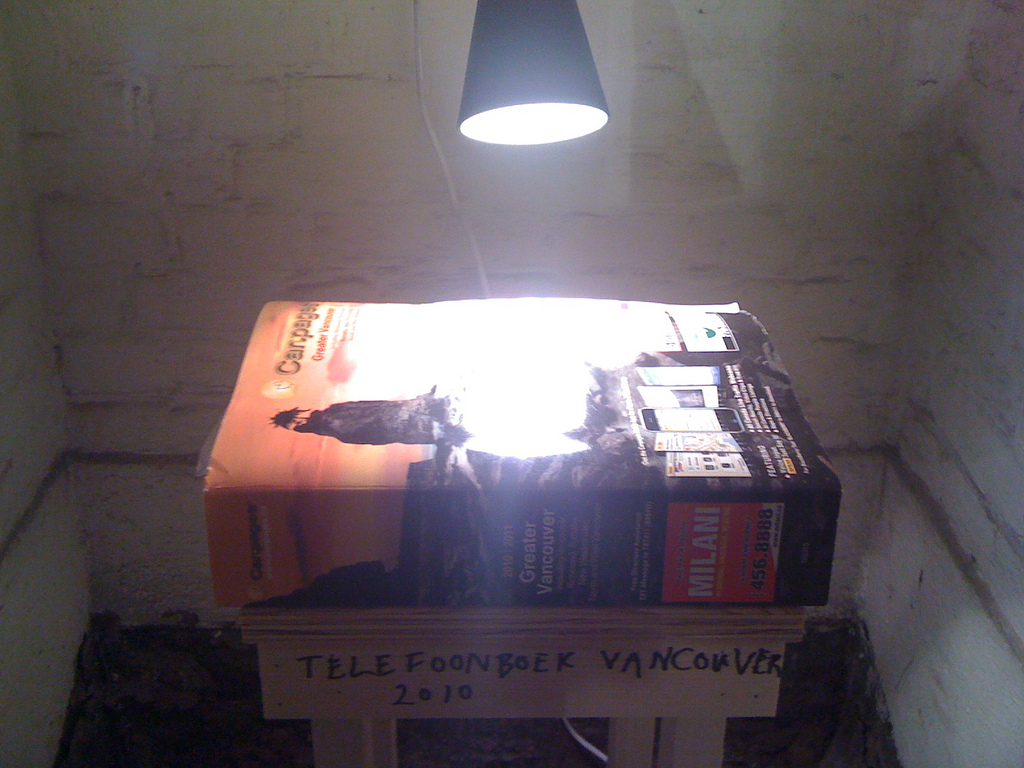
Library of Mailed Objects, (detail)- Vancouver/Canada Telephone Book, 2010 ( tel. numbers of people, government, and business in Vancouver ) mailed by Nietzsche Drager

igloo theatre, (detail) Children under the blanket watching a Surrealist Video (composed/edited by )- excerpts from black and white Surrealist films ( 1930′s-1940′s) woven with short scenes from,1. Alice in Wonderland movie, 2. Pee Wee’s Playhouse, 3. X-men advertising, 4. Silver Surfer film, 5. Beatle’s Yellow Submarine, 6. and Lady GAGA/DADA CAFE image.

Andre Breton Room, Andre Breton with sunglasses, exhibited in an vaulted room.

Detail : Andre Breton Room, Andre Breton with sunglasses, exhibited in an vaulted room.
( Recontextualization / Reframing / Art Action / Art Intervention )
KAAP 2010 Biennale
” DADA CAFE “
.
STORM, gallery/arts organization, Utrecht, Holland
Curator: Mark Kremer (NL)
Co-curator: Michiel Blumenthal ( NL / ITA )
Producer Kaap 2010: Mark van den Ham (NL)
Publiciteit + Marketing/ Internationaal Beleid STORM: Gouke Hilte (NL)
Project Leader + Practical Coordinator STORM: Hester Wolters (NL)
Afd. Educatie Stiching STORM: Ilona van der Heijden (NL)
KAAP 2010 Biennale is a biennale of 10 international artists whom exhibited and installed art in a 13th Century Dutch military Fort – Ruigenhoek. The primary audience for the Biennale was children, ages 3- 12.
ARTISTS
Tamás Kaszás : Prague/Budapest (b. Hung.)
Folly Teko: Woerden NL (b. Togo)
Maura Biava : Amsterdam (b. Italy)
Yael Davids : Amsterdam (b. Israel)
Yeondoo Jung : Seoul (b. Korea)
Saskia Janssen :
James Beckett: Amsterdam (b. Zimbabwe)
Nietzsche Drager : Vancouver (b. Canada)
Nina Yuen : Amsterdam (b. Hawaï)
Wietske Maas : Amsterdam (b. Tasmania)
Chairs, Table, Chessboard, Chess book, Oranges, String, Paper, Wood, Microphone, Electric Amp, T.V., Astro Turf, Blanket, Photograph, T- Shirts, Video, Lemonade Stand, lights, frame
DADA CAFE , an installation by Nietzsche Drager re- contextualizing / re- framing 1920’s Surrealism /Dadaism, in KAAP 2010 Biennale, an exhibition of 10 International Artists whom exhibited / installed art in a 13th Century Dutch military Fort – Ruigenhoek, Utrecht, Holland, for an audience of children, ages 3 – 12, incorporated five ‘stations’ in 3 vaulted brick rooms in the fort: Station 1.) “DADA Chess”. Surrealist Chess Board, a chessboard with an 18th Century Dutch/German chess instruction book. Station 2.) “Lemonade Stand”, serving lemonade for 25 cents – the lemonade cups had small holes in the bottom ( Younger children were partially confused by the cups leaking , yet older children told them to plug the hole with their fingers like a Dutch dike) Station 3.) ” Poetry Reading Room. a microphone and amp, where the participants could read from “Rock song lyrics ” ( 1960s- 1990s ), in Dutch and English, hanging from strings and detachable. Small square black wood seats painted with abstract expressions in hand written text for participants to sit in the room. Station 4.) ” Library of Mailed Objects”– eight objects on plinthes in small alcoves, mailed from Canada by Nietzsche Drager to Utrecht, STORM, 4 a ) Vancouver Telephone book 2009 4 ) Immanuel’s left Nike running shoe c ) A half consumed bottle of blue Gatorade 4d ) 30-45 collectable comic/t.v series cards ( 1960-80s) e ) Five issues of the 1960′s revolutionary Paris magazine – L’Enrage f ) one dutch train ticket g ) one nail, h ) pepper shaker. Also, Nietzsche Drager mailed 25 posters taken from the cafe’s bulletin board at Emily Carr University of Art and Design, to be installed behind the objects. Station 5. “ Igloo Theater ”, a movie/film room- a carpeted floor, a large television, a very large blanket over the television and 6 meters in front of the T.V. permitting the audience to watch the movie from under the blanket. The 30min film composed by Nietzsche Drager mixed short excerpts from black and white Surrealist films ( 1930′s-1940′s) with short scenes from, Alice in Wonderland movie, Pee Wee’s Playhouse, X-men advertising, Silver Surfer film, the Beatle’s Yellow Submarine, and Lady Gaga/DADA CAFE photo ( installation logo)- designed by Nietzsche Drager and Gouke Hilte ( STORM, publicist); permission from Universal Records, Lady Gaga, Holland. Further interventions, Station 6, included a large framed photo of Andre Breton wearing sunglasses hovering in a room, and two volunteer Hosts- Dutch teen youth, assisting in the installation, wearing t- shirts prints; one, with a Theo Van Doesburg painting – Dutch Dadaist, and another with a Man Ray photograph- French Surrealist. further, ‘DADA CAFE” text written in sliced oranges above the arch in the main room.
Dada Cafe recontextualizes, represents, adapts and morphs Modern Avant Garde 20th Century Surrealist/DADA art by using 1960’s American Conceptual Art Practices, architectural and aesthetic design, and Continental Philosophy- Deconstruction ( Derrida and Foucault) creating a stage.
Nietzsche Drager collaborated with the STORM organization via email from Vancouver to Utrecht to organize an installation of 6 works or ‘stations’ in 3 vaulted brick rooms in the fort. STORM installed the wok, and assisted in selecting parts of the installation.
The DADA CaFE, recontextualized Modern Avant Garde 20th Century art into a 13th Century Fort, for children, via contemporary conceptual art. Based partly on Immanuel’s M.F.A. thesis on Surrealism, the installation was designed to express and reframe the “Surreal DADAist and DADA SUrrealiST “, from 1920s Paris in 2010 Utrecht Holland. The key notion in this work and co-relations between the Surrealist art and biennale was freedom and play, or the freedom of play.
Dada Cafe was a collaborative work with the Initiator/Curator, Mark Kremer, and Co-Curator Michiel Blumenthal, with assistance from the STORM organization, namely, Mark v H ( Producer Kaap 2010 ), Hester Walters ( Project Leader + Practical Coordinator STORM ), Gouke Hilte ( Publiciteit + Marketing/ Internationaal beleid). and Ilona van der Heijden ( Afd. Educatie Stiching STORM ); and also KAAP 2010 Volunteers hosting and assisting this exhibition.
( INSTALLATION ART / PERFORMANCE/ COLLABORATION / ART )
Leary Lennon Love”, 2009
( PERFORMANCE/ COLLABORATION / ART ACTION / ART INTERVENTION / RECONTEXTUALIZATION )
Leary Lennon Love”
DOLMUS FESTIVAL , Gallery Neiwe Vide, ( Holland )
ft. THENEWCOLLAGISTS – Johanna de Schipper and Kelly Kersenns
2009
Curator: Emile Oursel / Assistant + Video + Photographer : Christoph Both- Asmus
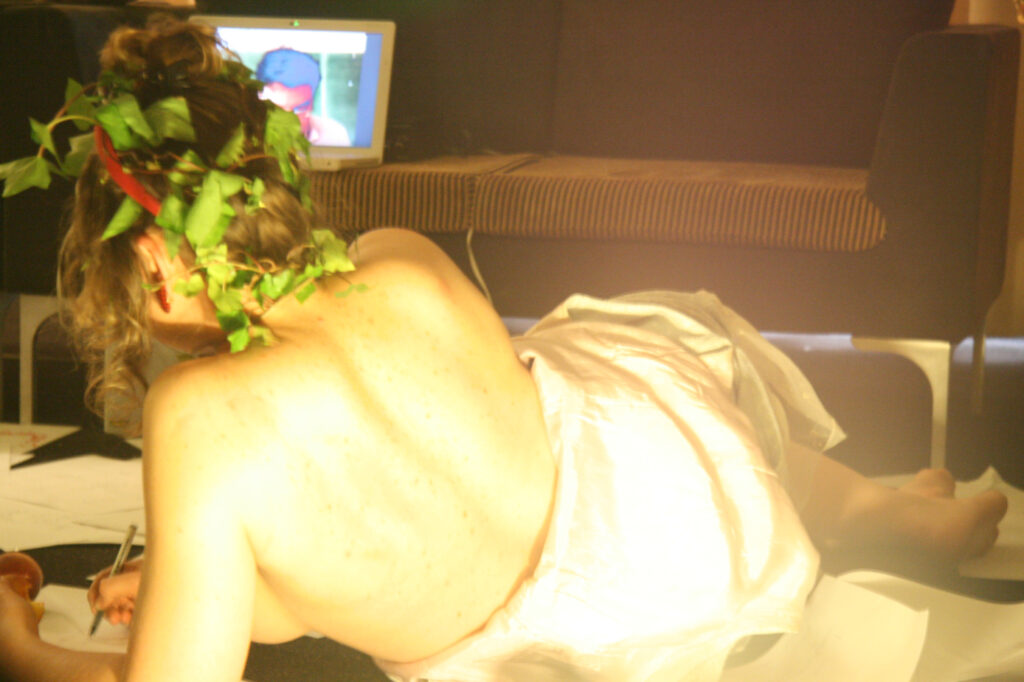
Leary Lennon Love is a skype collaborative performance. Immanuel invited Johanna de Schipper and Kelly Kersenns (www.newcollagists.com) to collaborate and improvise a performance in the moment, to a reading of his lecture, Dada/Surrealism + Buddhism: a Query into the Transspace of the Spirit).
On the day of the performance, Saturday June 13th 2009, a small audience collected at the Llyod Hotel. They were driven by a mini-bus ( part of the Dolmus Festival structure designed by Emile Oursel whereby the audience was shuttled to the performance in Haarlem from Amsterdam) to the Amrath Hotel, Haarlem. In the mini-bus, I placed 5 -7 Dutch and British 1960s newsprint magazines: I also had a sound/audio recording from the San Francisco International Airport, when I was there in 2005 for a group poetry reading at the Elbow Room organized by 580 Split/Journal Issue ( # ) launch, playing on a small ghettoblaster in the mini bus while it drove to the hotel.
The audience of 3-5 people where “sneaked” into the Amrath Hotel into a room that was set up with a Mac computor, audio equiptment, and recording equiptment. The audience arrived early. They had been waiting for my skype from Vancouver, Canada, for almost 1.5 hours. At about 18:00 Amsterdam time, we connected on skype. From the University of British Columbia, SCRF 201, in an empty lecture room, ( with one assistant recording) I read the lecture.
The lecture:Dada/Surrealism + Buddhism: a Query into the Transspace of the Spirit, incorporated the text; Pablo Picasso poems/ excerpts from Immanuel’s thesis on Surrealism ( Surrealism + Revolution : An analysis of the Surrealist’s writings + poetry and Surrealist’s life in the Surrealist Revolt towards a query concerning the presence of elements of Surrealism in Contemporary Western Media ) / Michel Foucault quote/ Antonin Artaud /Mary Ann Caws poetry / contemporary conceptual artist, Braca Ettinger ( exerpt of a lecture ) / Sylvia Plath poem / George Orwell, 1984, exerpt / Allen Ginsberg poem / jack Kerouac poem / Benjiman Peret poem / Interview with curator: Mark Kremer, on Surrealism / Andre Breton quotes.
__________________
Chance was a medium from the beginning.
Organized and coordinated from Canada, I requested Christoph both-asmus to assist and coordinate the project with Emile Oursel in Holland.
At a party Christoph met the New Collagists, and they agreed to collaborate.
.Emile Oursel chose the hotel.
The New Collagists did not know my lecture. I did not know how they would do their performance.
Kelly Kersenns
Johanna de Schipper
http://bookstoreproject.nl/team/johanna-de-schipper/
( INSTALLATION ART / PERFORMANCE / COLLABORATION ART )
Conversations on a free Democracy, 2009
Conversations on a free Democracy,
video 98 min
A.K.I. ( B.F.A. School) Universitie Twente, Enschede, Holland
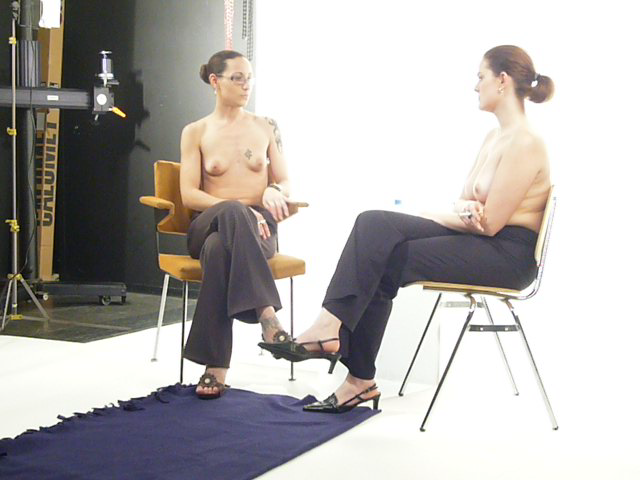
Participants: Life Drawing Models: Ester + Kim
filmed by Sander van Wettum (NL)http://www.sandervanwettum.com/ + photographed by Nietzsche Drager, 2009, at, A.K.I. ( B.F.A. School) Universitie Twente, Enschede, Holland
video exhibited, Prognose voor de Toekomst / Prognosis for the Future , Gallery ST. Havenkwartier, Deventer, Holland, 2010 , cuao , Harm van der Wal
Conversations on a Free Democracy is a video work filmed in the A.K.I Art Academy (Universitie Twente, Enschede, Holland)Drager randomly selected and invited two Dutch female life- drawing models to answer, in the moment, 7 to 10 questions on Dutch politics, cutlure, sexuality, gender, and identity. Filmed by Dutch contemporary photographer- Sander van Wettum, the work in an institutional context develops dialectics on Marxist class, immigration, identity, nationalism, personal and political, individuality, power, voice, agency, history.
Conversations on a Free Democracy, was a model video for a submission proposal to Viva Arts Action! 2008 ( Montreal, Quebec,) a Performance Festival. My proposal was to invite two Quebec female actors to re-enact the Trudeau- Levesques 1970 debates. Pierre Elliott Trudeau was an Federal politician interested in maintaining the unity of Canada, and Rene Levesque was a Sepertiste Quebec politican interested in the province of Quebec becoming an independent nation. Both politicians passionately debated. The result was Quebec voted stay in Canada. In my proposal, the French speaking actor would play Rene Levesques and the English speaking actor would play Pierre Elliott Trudeau, in a series of recontextualized debates in Montreal, at Concordia University and Universite de Quebec. Both actors would be topless, wearing white pants or skirts. The debates would be free for university students, and Media, documenting and presenting the debates live on CBC-Radio Canada, in English and French. Viva Arts Action!, of course, has yet to reply
Conversations on a Free Democracy, is both a video art work and art intervention. It is a stage for questions. A free space. An ideal space. Where political and cultural questions can be answered in a unique environment and moment – an construct of a stage, within a pholographic set, and semi naked.
I selected a range of topics that would be political and polemic ie. what is Dutch Culture, what are social problems in Dutch society, and how the Dutch culture embraces sex or sexuality, and asked the two participants to develope the questions in the moment into dialogues.Because the two female participants were partially naked, their answers to my questions, I believe, were changed by this aspect, in ways which can not be necessarily undestood by sociology or pyschology, yet a reframed transpersonal experiential.
To be naked is theoretically vulnerable, but it is also, natural, and a power.
Probably Ancient cultures had a different view or experience of the naked body than we do in Modern Democratic societies ( Michel Foucault discusses how Greek Culture 4AD and Roman culture had less of an individualized sense of sexuality.)However, .for us now sexaulity is perhaps not repressed, yet oppresseed even as sexuality is mediated, generally, as social beings, we still hide our bodies with clothes, we shame our bodies with morality or politics, we glorify them as temples with youth culture, we critique them from elitists ideologies, etc .
And there is an odd/unique/conflicted relationship between our Mediated body and our real body. It is part of our contemporary identity, this mediation.
When two people sit partially naked together, in a private space with an objective to answer questions, in the bright photographic light, on a stage, in a overall dark room, of an art institution, with two other individuals, and are filmed, a type of interpersonal and delinking from social norm can perhaps ellicit more open dialectics and discourse.
Of course, the answers by semi naked individuals depends on many other things; their histories; their politics; their personalities; their feelings; their self censorship; their fears,etc. And being filmed may or may not increase these things to alter or shift dialectics.
However, my hypothesis is, their answers to these same questions, not on this stage, not in this context – a designed set to alter the social function, would be “less engaging”, or with “less depth” or with “less detail” or “less passion”. A stage and nakedness provides potential “difference” (Derrida).
With this work, I am exploring dialectics as an art media.
In, 2010, the video ” Conversations on a Free Democracy “, was exhibited, unedited, and unknown as to what Ester + Kim answered to the questions in the video, in, Prognose voor de Toekomst / Prognosis for the Future , at, Gallery ST. Havenkwartier, Deventer, Holland, 2010 , curator , Harm van der Wal
1. Sander van Wettum
http://www.sandervanwettum.com/
( INSTALLATION ART )
Sentence, 2005 – present

I wrote the word “MEDIA” inside the Cubicus building on the Universite Twente (Enschede) campus (after several times of passing by the building in the summer to admire the modern architecture). In my investigations, I had noticed signs in front of the building that indicated there was a communications department. In the context of the aforementioned, the word “MEDIA” was chosen as a site specific intervention. On the day of the intervention, I wandered into the building and commenced a process of intentionally getting lost. I felt excited in the search for a space to write the word “MEDIA”. Having found a slightly private space, with great architectural elements, I proceeded to write the word ”MEDIA” on the floor. During the process of writing, a woman came out of the office directly behind the word, and we entered into a conversation. I said I was doing an art work, and that I would clean up. She said …. “and take pictures”. I said “yes”.Then, she left. I continued to work when, surprisingly, she returned with a small broom and a dust pan and offered it to me. I thanked her, and continued to work and document. Afterwards I cleaned up immediately, and left the small broom and dust pan by her office with a note….” Thank you for understanding….. dunk u well…… fina dach….. have a nice day”

I randomly wrote the word “MAP” inside the lobby of the mathematics building called the Citadel at Universite Twente (Enschede). Several mathematicians, who walked over the piece several times as I documented, were interested in the project and we talked briefly. They asked if I wanted a reaction …. I asked what their reaction was. Their response was that the word MAP was similar to the abbreviation of their club called the AAMP. Later, in a small conversation with myself on the work, a professor stated that a map was a mathematical concept. He said…. “you did not know this” and I said…. “no”. The choice to write the word MAP was random and the building was selected because of my attraction to the large expanse of modernist windows forming a wall which was the lobby atrium.


After writing the word “MAP”, I had some modosodium glutamate left over….and was thinking of an area in a small forest on the campus ( a place I had visited earlier in an exploration of the campus during the summer). I conceptualized the space in the forest and believed it would be suitable for a medium sized word. I decided to randomly chose the word by looking through past photocopies of theory texts from the University of British Columbia …..i felt attracted to Alex Comfort ‘s “Art and Social Responsibility” ….and I choose the word “SOCIAL”. Once in the forest, I wrote the word “SOCIAL” on a path and documented. At the time, I felt social with the environment and nature. However, it was after I developed the pictures that I realized there was a possible interpretation of the trees having a social consciousness, and talking or sharing with each other, a science concept.

With five kilos of white sesame seeds in my travel bag, I took the train from Enschede to Amsterdam, with the intentions of writing the word “EAT” outside the Stedelijk MUSEUM on Wednesday 14 March 2007. Arriving at the Stedelijk building, I had to change my intervention as there were vehicles parked on my initial installation site. I looked around and explored the area in front of the entrance to the building which was also a parking lot. Within minutes, I found a new site in the parking lot, between the entrance of the building and the stairs leading outside of the parking lot. At this point, I realized the installation would possibly be social, and observed that I could include the Stedelijk Museum sign in my work. I decided to write the word “EAT” using Philips C.D. covers; however, the wind kept blowing the installation apart. A man in a suit walked by and said “Kunst” and I said “yes.” Changing to white sesame seeds, I began to write the letter E when a gentleman came up and asked “ what happens when the wind blows it away” and I responded…… “ I will be sad” ( which I did not believe, and perhaps neither did the man…. as he laughed). During the drawing of the letter A, a girl asked what I was doing…..i responded generally about the notion of consumption of knowledge and a demarcation in public space and she seemed to neither agree nor disagree. Then, a lady asked for directions to the museum….i directed her ( later she asked other tourist type of information….I was intrigued of my new role as a Dutch cultural guide ), and upon completion of the word, two girls who had been briefly watching, left in a hurry, as I brought out my camera to document. During the documentation, several people passed by, and only some noticed the work, at which point, I saw Professor Jord den Hollander walking out of the building and showed him the work: he stated the word “EAT” actually said FAT when he first saw it. Also, he said that some of the animals from the area may come by and eat the word. As the conversation concluded, I went to café 11 ,on the eleventh floor of the building and drank beer and coffee while writing and in conclusion of this, I went down to the word “EAT” and documented people walking through the work. There were two girls who seemed very interested and carefully looked at the installation intervention…and in a conversation I learned one girl happened to be a white sesame seed enthusiasts. Her friend said that she should eat some of the seeds. And in agreement, Sabine went over to the word and pretended to eat seeds. I documented her art action. And afterwards gave her a one kilo bag of white sesame seeds….as a thank you and continuance of the work. Weeks later, in my studio at the Dutch Art Institute, Florian said he saw the installation of the word “EAT” and that birds were eating the white sesame seeds. This information also extended the work into a type of communication and narrative, and in doing so, suggested the white sesame seeds were a “media”

On 14 March 2007 Wednesday, after writing the word EAT outside the Stedelijk building, I decided to search for an interior space in the building to create a two or one letter word. The space I discovered was the lobby interior entrance of the Stedelijk Museum on the second floor. I wrote the letter “A”. No public were present; however, during the installation, a security guard visited to ask me questions. I said “ I was a master student from the Dutch Art Institute creating an installation as part of my thesis, and that I would remove the installation.” he responded how long will I be….i responded ten or fifteen minutes, and he said “ok” and left. Then, slightly before I had finished documenting with several hundred pictures, the security guard returned….and further inquired as to the completion of my work. At this point, my intuition of surveillance video cameras was confirmed: it was an interface of relations between medias …
..Philips c.d. covers and security video cameras


“Sentence”,
Public Installation:

Various Locations,

2005 - present


Sentence,
( Public Art Intervention)

Materials: white sesame seeds, bread, plastic c.d. covers, flour, water,

Size : various sizes,  1 ‘ x 3′, 3′ x 8′, 5′ x 20’
                                                                                                               Site: Vancouver, Victoria, Toronto, Montreal, Amsterdam, Rotterdam, Deventer, Enschede, Paris,

2005  – present


In 2005, in Montreal, I wrote a large single word on the ground with flour using a spoon. Carrying a bag of white flour in a knapsack, wandering the city,  I found an interesting secluded public location near the Musee d’ Art Contemporain and in the bright afternoon sun, wrote the word ” AT “. I then decided, when I felt inspired, to write other words, both randomly and deliberately, in various public urban spaces.

This research project began by recontextualized the ‘act of painting’ – pouring with a spoon white sesame seeds. My academic art tradition or genesis or seminal mode was painting. Particularly Abstract Expressionist Painting. New York. Translating installation art into a painting gesture was not political, merely natural. The idea to write a continuous sentence over a period of time and different cities happened by chance. In fact, chance informed, where I wrote, and the materials selected. Both ‘chance’ and Tristan Tzara’s cut up’ were intentional Surrealist techniques or concepts I embraced, because in 2000 I began writing and publishing poetry in literary journals. In 2005, I read poetry as part of the 580 Split publication journal launch, in San Francisco, at the Elbow Room. My poetry was very abstract, constructed stream of consciousness, with juxtapositions of theory and conceptual art. How words can have non- meaning while convey meaning is a subtext of Continuous Sentence. Similarly too, how words corelate with the environment in a literal and symbolic theatrical way informs this research. In my overall art journey, since 1990 to present, text/words/language has popped up, has emerged; the art of language and literature and language compared to art seem to share the notion of the ‘impossible possibility of communication’. A phrase I believe I have heard somewhere. Communication is a labyrinth of Essence.

Continuous Sentence involves concepts of Public and Private space, agency, communication, language, history, Surrealism, Theory, Conceptual Art Strategy, Urban Development, Urban Planning, Performance Art, Culture, Sociology, Psychology, Narrative, and Technology.


A series of text installations / art interventions in public space placing text onto the environment .
( INSTALLATION ART )
Silver Surfer, 1995

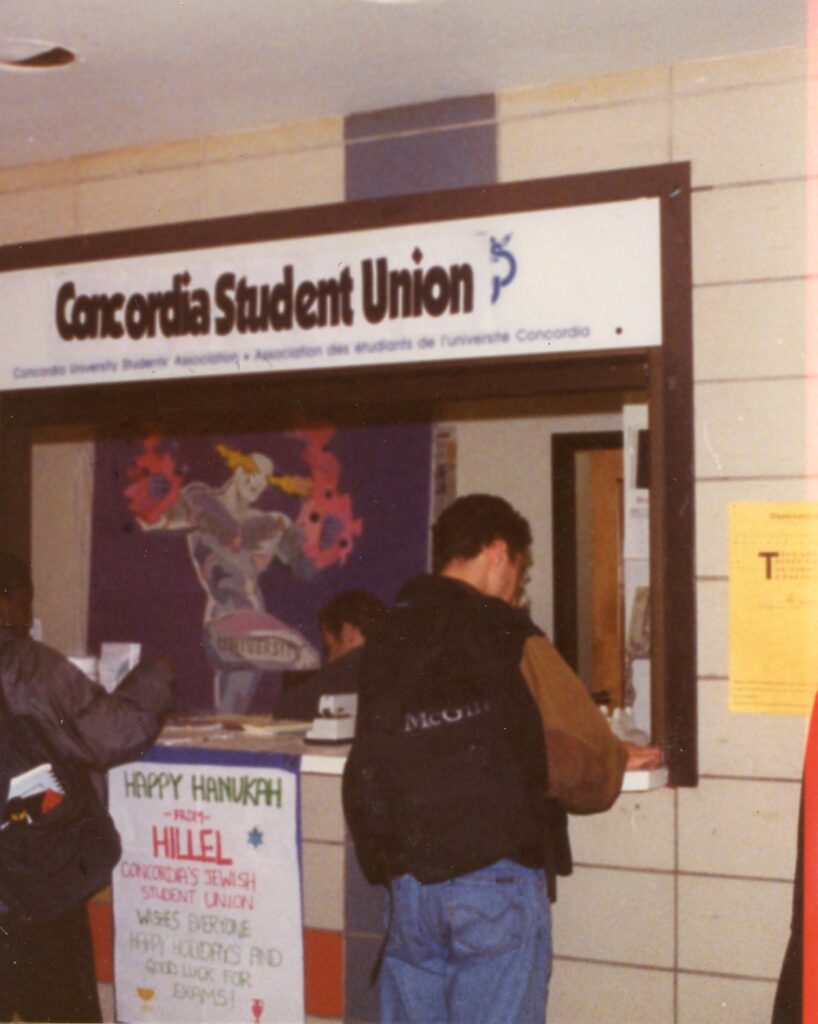
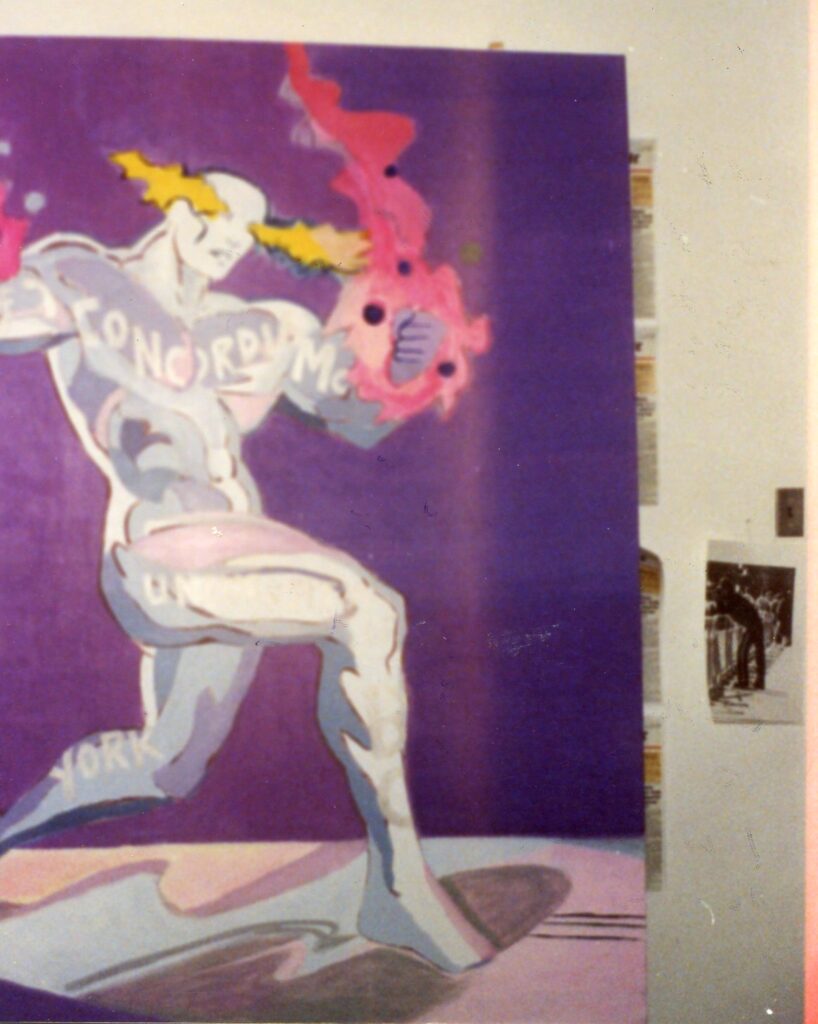
Silver Surfer, Acrylic on canvas, 6 feet x 8 feet, installed in Concordia Student Union Offices Concordia University, Montreal, Quebec, Canada
( INSTALLATION/ PAINTING/ ART ACTION / ART INTERVENTION )
Silver Surfer,
Painting
Acrylic on canvas,
8′ x 6′
installed in Concordia Student Union Offices Concordia University, Montreal, Quebec, Canada
1995
Leading up to the student Tuition Increase protest in 1995 in Montreal, Canada, I painted an 8′ x 6′ canvas depicting the Silver Surfer with the names of five Canadian Universities written on his body: U of Toronto, Mcgill, Concordia, York Univeristy, U.B.C . Donating the painting to the Concordia Student Union to support the political resistance of unreasonable tuition fees for Post Secondary Education, a fundamental Human Right, and not a privilege, however one strives to define privillage. And theoretically all education, globally, and of course in Canada, and especailly Quebec, a key pillar in Canadians founding cultures, where freedom and decmocracy represent something both romantic and human, where amazing bi lingual and non billangual Quebec students also felt we need to stop the over taxing of students by governements and corporatiazaing of knowledge by Private Money. Idealily, all students agree that like water, education is a need and substance of great economies and communities, and thereby offered, in my imagination, Canadiani eductiona should be Universally Free ( or more accessible), ie. the Sorbone ( France) model of Education. I also donated a second painting, acrylic on canvas, 8′ x 6′, depicting four naked students- two make and one female, being hung- executed, with slogans on the painting, to paraphrase ” Eduction is right” and “Starving Knowledge”. This painting was not displayed in the lobby of Concordia, however was presented in the protest march as students gathered in the main lobby of Sir George William.
Some of the students working in the Concordia Student Union offices, said the Silver Surfer painting was too bright. In fact, dizzy, or disconjointed may be more accurate and specific definitions. Yet, the over all feeling, was perhaps, a type of frustration with bright pink, and purple and so on. To paraphrase, ” it was almost too bright and too colorful, therefore making it difficult to work.” My reaction to their response was trying to visualize this difficulty. Somehow, color theory and sociology were interesecting, yet I did not care, in the moment, to figure out this concept. So they had to move the painting outside of the offices, in the main lobby part. My photos show the painting in the office.
I also made posters out of the link newspaper, and displayed them in classrooms and bathrooms. It seemed relevant. I was glad to complete the task. I was not being payed and I was interested in leaving the politics to a simple 2 or 3 day action. And then continue on with art for art sake. For me, I enjoyed the social of politics and art, yet found I needed more energy and economic reason, or make it more artistic, which cost money, so I delimited my activity to rational time effieciency models, namely saying, just a few days and then move on. A lot of subsequent public instations, and art actions and intervetions, had some notion of budgeting time, energy and goal objective. For some reason, instation art which could be finite, complete, and non relational or universal and outside of my ouvre seemed functional.
After I particpipated in the March, with friends, and thousands of students from 5 Universties and about 10 Colleges and Cejeps,
In Montreal, Quebec, Canada, 1995, the Provincial Government, wished to increase student tuition fees by a large amount. Many of the Universities, Colleges, and Cejeps, united, French and English students, fighting for a “fair chance to a have prosperous future, and a post-education cost that was reasonable”, and challenged the government’s position of a educational system for the wealthy or competing intelligencia via scholarships and bursaries- an elite way to decides who succeeds or permitted opportunity. Concordia University led the way in organizing this large student march happening at the end of the student year in May. Collectively, Concordia University, Mcgill University, Dawson College, École de technologie supérieure, Université de Montréal, Université du Québec à Montréal, Cégep André-Laurendeau, Cégep de Saint-Laurent, Cégep du Vieux Montréal, Cégep Marie-Victorin, Collège Ahuntsic, Collège de Bois-de-Boulogne, Collège de Maisonneuve, Collège de Rosemont, and many others marched in the streets in protests, including letter writing campaigns, etc. The march took place on (? April 1995 ) with 20,000 + students.
After the March, the President of the Student Union, thanked me. She said, to paraphrase, ” Thanks for making our cause colorful” I walked away, in reflection. Contemplating philosophically, did I just make the political resistance/voice/expression, … more pretty? Did I make it less serious and more fun, like entertainment, like Mass Culture- television, or maybe sports color commentary? Was making “conventional politics” more colorful and palatable, a dialectic. Does this mean Goya’s etchings, and perhaps Picasso’s painting Guernica, are simply aestheticizing poltiics rather than critique in the minds of the public? Yet maybe people need, in polemics, to be colorful. sometimes That color can be discursive. Then, I returned to the studio, to paint basic flat color, thinking of nature: beauty, maybe theoty, yet no discourses, just thinking, or just being in nature.
Then, in 2012, all the Montreal Universities had to fight again against tuition increases. It lead to months of street marches and protests. And eventually the students forced the Premier Jean Charest, the Quebec Premier, to resign, and stop the tuition increases, finally.
“The 2012 Quebec student protests were a series of student demonstrations led by student unions such as the Fédération étudiante universitaire du Québec and their supporters against a proposal by the Quebec Cabinet, headed by Liberal Premier Jean Charest, to raise university tuition from $2,168 to $3,793 between 2012 and 2018.[2] As part of the protest movement, a series of widespread student strikes were organized. An estimated one-third of students agreed with the boycott,[citation needed] with the rest completing their courses.[3]Left-wing groups endorsed the student protests, which evolved into generalized demonstrations against the provincial government. Opposition parties (Parti Québécois, Québec solidaire, Option nationale), workers unions (Confédération des syndicats nationaux, Canadian Union of Public Employees) and many “fringe” groups have demonstrated alongside the students in April and May 2012.[4]On May 18, the Government passed Bill 78, an emergency law to manage how protesters conduct their demonstrations and ensure students who wanted to attend classes would not be barred from entering schools which led to further protests.In the Fall of 2012, with a new school term beginning, student participation in the strikes and demonstrations dwindled. The leftist, Quebec nationalist Parti Quebecois was later elected as minority government and halted any tuition increases in line with a campaign promise.[5]( http://en.wikipedia.org/wiki/2012_Quebec_student_protests)In 2012, the Charest government faced major challenges when students protested and went on strike by boycotting classes to protest planned tuition increases. After this continued for several months, the government passed Bill 78 to impose restrictions on protests; this caused controversy, with the Barreau du Québec among others expressing concern about possible infringement of constitutional rights. ”
( http://en.wikipedia.org/wiki/Jean_Charest )
( INSTALLATION ART )
For Sale our f**king future” 1995

( INSTALLATION / ART INTERVENTION / ART ACTION )
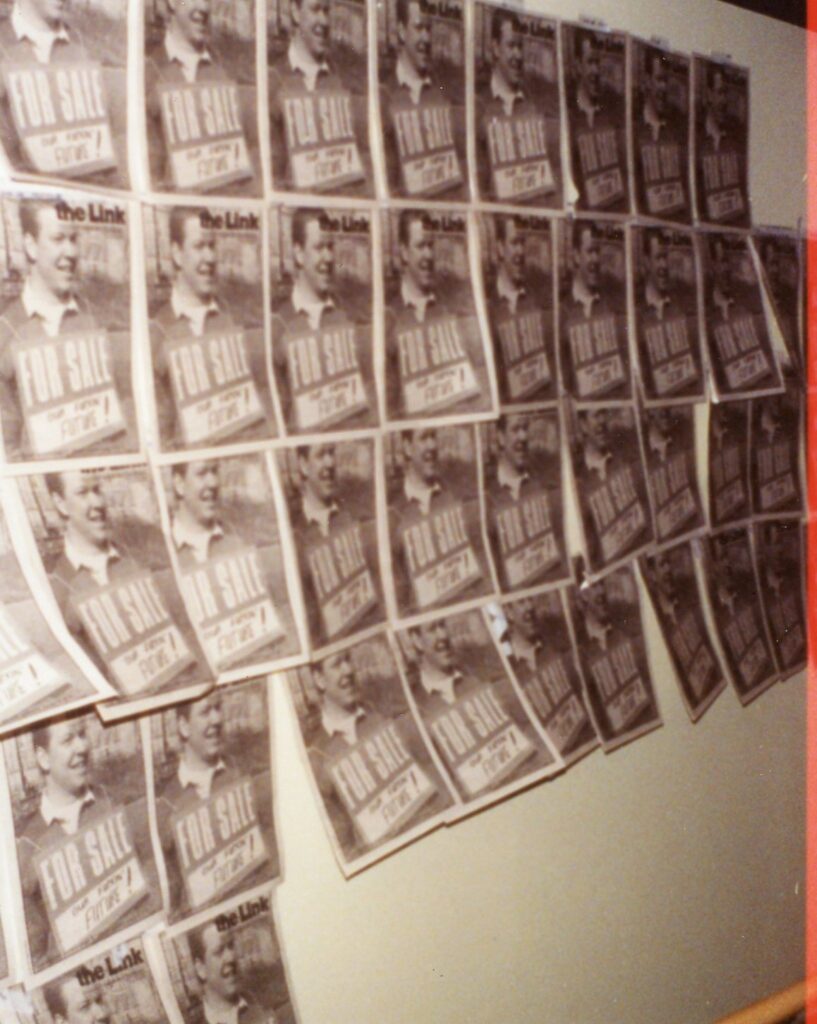
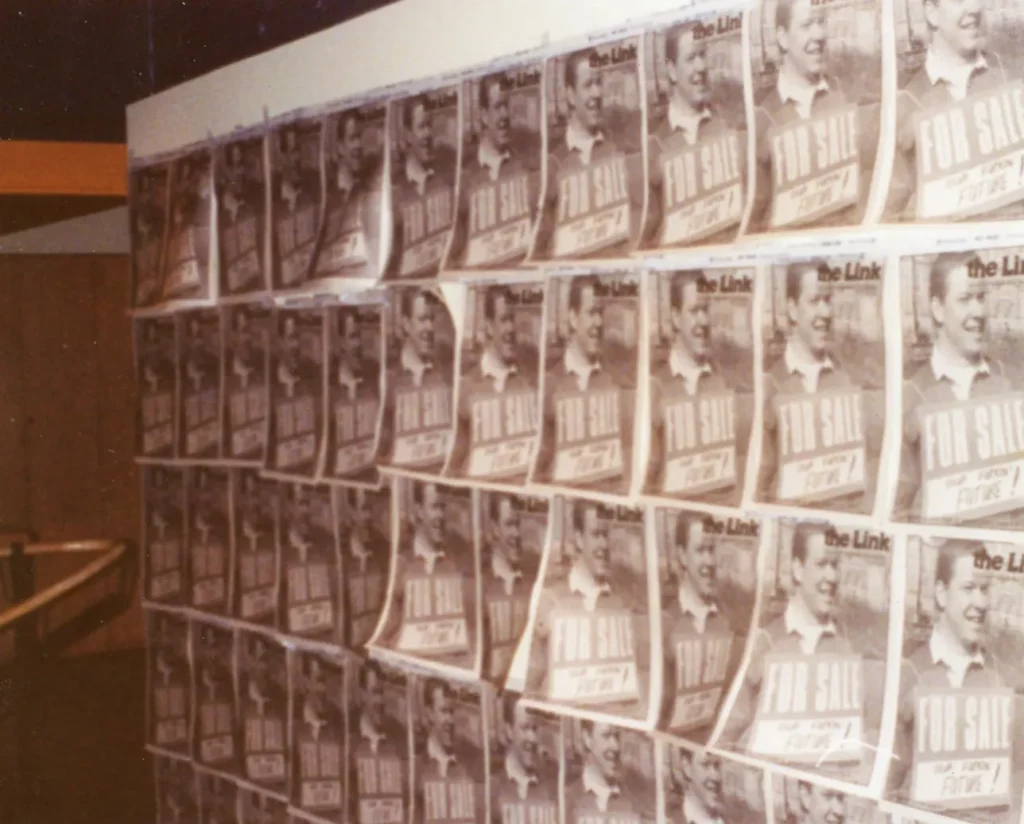
“For Sale our f**king future” 1995
100 “LINK” Concordia Student Newspapers
24″ x 18″
installed on wall 12′ x 46′
Cafe, Sir George Campus, building,
Concordia University
1995
With the permission of the Cafe manager, I installed approximately 160 pages of the front page of the Concordia Student newspaper- The LINK, on a cafe wall. The Link’s front page was a Student? wearing a FOR SALE sign where it was written, “ Our F**K’n Future”. I wished to share this political message further with the Student Body, for the upcoming Student Protest Tuition Fee Increase March / May 1995. Installing at approximately 2 pm, in March/April, I spent about 2 hours taping the newspaper with green painting tape on the wall. The tape did not entirely hold the paper to the wall for long. Thus, my installation became a type of un- predicted performance- taping up individual or random sections of slowing falling off the wall newspapers. The cafe customers were the indirect audience. Around 5pm the Cafe Manager showed up, we met for the first time, and he saw my installation for the first time. To paraphrase, his first words to me were…. “The Link, …I hate the Link!!!”. My reaction and first words, to paraphrase, “Oh.” I immediately took down the installation.
I see this installation as reframing the original image- front page of a newspaper, in a new context- cafe. This work was to motivate the student body towards greater “conventional political” involvement and dialectics. Mediated communication, particularly hard copy, or print, is a potential vehicle to share, expand, re-engage, diversify, the original text or image or idea, sometimes morphing these in the re-representation. Walter Benjimins Art in the Age of Mechanical Reproduction needs to include the extension of the machine image by further reproducing or representing by personal intervention: we can perhaps view this furthering as economic, and the ‘personal intervention’ reconstructing ‘mass intervention’.
uhe, I was compelled y he ac he suden, wih his son polical saemen, looked like a “conseaie” suden – ie weain conseaie clohes, hai syle, maye en an Economics Majo, so no he usual “poliical poesin” asy anachis. I houh, i his “eeyday” conenional lookin uy, can ” e pulically poliical”, hen we all can and should e moe enaed in all ypes o posie democaic poliical esues, like maches, wiin lees o he oenmen, ec.
( INSTALLATION ART )
” Forest ” 1999

” Forest ”
Paper, pens, candles, incense, dirt, leafs
4 feet x 4 feet
1999
( INSTALLATION ART )
Joseph Beuys Bus Stop, 1996

( INSTALLATION ART )
Joseph Beuys Bus Stop, 1996
Masking tape
4 feet x 5 feet
Bus Stop
1996